The Fly Report From AJL

Comply To Fly?

OVERVIEW Graphics 

GRAPHICS

See all graphics

FIndings

Is a voluntary pilot becoming the default way to travel without consent or oversight?

The Comply To Fly? report by the Algorithmic Justice League focuses on the facial recognition program operated by the Transportation Security Administration (TSA) at U.S. airports. While originally described as a “pilot” or “proofs of concept” by TSA, the program has steadily expanded to over 250 airports as of May 2025.

This report draws upon hundreds of travelers’ lived experiences, through AJL’s Freedom Flyers Campaign. Launched in 2023 as part of its goal to provide everyday people with a means to share experience with AI, the Freedom Flyers Campaign has sought to gather feedback on people’s lived experiences with the facial recognition program conducted at TSA checkpoints. Through this participatory data gathering initiative, AJL asked travelers to submit a TSA scorecard documenting their experiences, informed travelers of the right to opt out, and invited them to share their experiences on social media and with others in their communities.
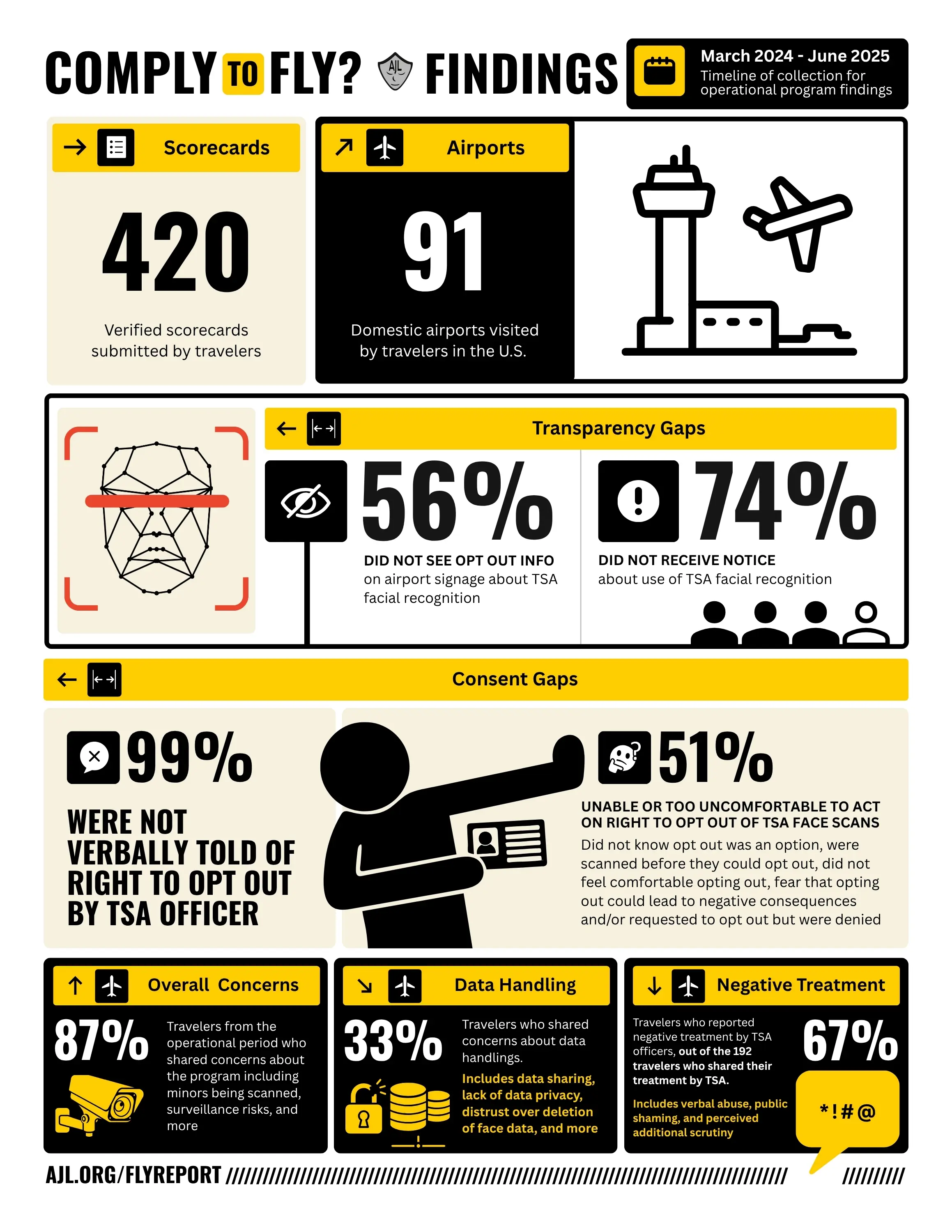
Infographic of the Comply to Fly? Findings

TRAVELER TESTIMONIES

“All travelers ahead of us were not informed of their right, and TSA was very quick to push them through to the scanner before they had a chance to see the signage. We saw moms struggling with their kids being pushed to the scanner without any opt out options being presented to them.

There were dozens of screens all around the TSA line that displayed everything except the opt out information and instead the opt out information was printed on a measly letter size paper only readable right in front of the scanner.”

San Francisco International Airport, July 2024

“I walked up to the TSA agent [...] and didn’t get right in front of the camera. I was instructed to stand in front of it and I told him “no thank you on thank you [sic]” his response was ‘really? That’s ridiculous, you must be stupid’ ”

Seattle-Tacoma International Airport, December 2024

“...I got in line for security and presented my driver’s license to the agent. The agent asked me to stand in front of the camera. Knowing my rights, I asked if I could opt out of the photo. The agent got angry, raising his voice to tell me that ‘we already took your picture’ and that there are ‘a thousand cameras in this airport . . . there’s a camera in your phone too.’ ”

Fort Lauderdale-Hollywood International Airport, October 2024

“I am concerned that millions of people will be roped into a program that compromises their privacy and uses their likeness without their consent. The signage at the airport was insufficient for passengers who cannot read English or Spanish. If the TSA were concerned about the privacy and security of passengers, they would make it abundantly clear that passengers can opt out. I was in line with half-asleep people who were unlikely to pay close enough attention to a small sign or assert themselves in front of an apathetic TSA agent.”

LaGuardia Airport, June 2024

“TSA agent immediately bereted [sic] me. Sighed heavily and made it clear I was inconveniencing him. Visibly angry with me. Sent me to a different agent because he didn't have the right tool. That agent didn't have the right tool either and sent me back to the first agent. I was told I had to wait for them to fetch the right tool, which took approx. 10 min. Was treated with extreme rudeness the entire time.”

San Francisco International Airport, September 2024

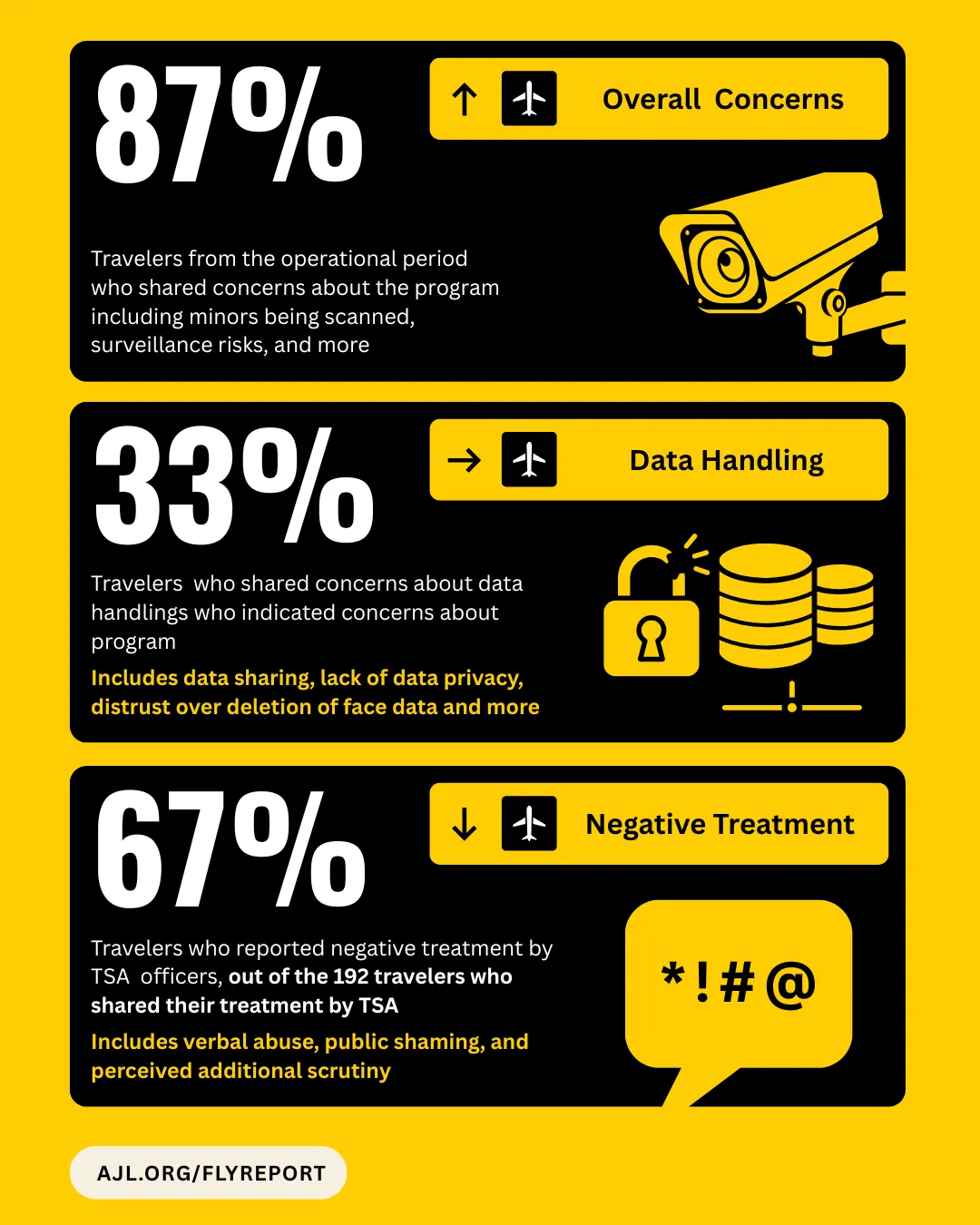
“... I am concerned about what agencies/groups might have access to my face data and use it to track me anywhere in the country/world.”

Long Beach Airport, September 2024

“The entire experience left me deeply unsettled. It's concerning how easily people surrender their privacy for the illusion of convenience, unaware they have a choice. It's a stark reminder that we must remain vigilant in protecting our rights, even in the face of seemingly benign procedures.”

El Paso International Airport, September 2024

“All travelers ahead of us were not informed of their right, and TSA was very quick to push them through to the scanner before they had a chance to see the signage. We saw moms struggling with their kids being pushed to the scanner without any opt out options being presented to them.

There were dozens of screens all around the TSA line that displayed everything except the opt out information and instead the opt out information was printed on a measly letter size paper only readable right in front of the scanner.”

San Francisco International Airport, July 2024

“I walked up to the TSA agent [...] and didn’t get right in front of the camera. I was instructed to stand in front of it and I told him “no thank you on thank you [sic]” his response was ‘really? That’s ridiculous, you must be stupid’ ”

Seattle-Tacoma International Airport, December 2024

“...I got in line for security and presented my driver’s license to the agent. The agent asked me to stand in front of the camera. Knowing my rights, I asked if I could opt out of the photo. The agent got angry, raising his voice to tell me that ‘we already took your picture’ and that there are ‘a thousand cameras in this airport . . . there’s a camera in your phone too.’ ”

Fort Lauderdale-Hollywood International Airport, October 2024

“I am concerned that millions of people will be roped into a program that compromises their privacy and uses their likeness without their consent. The signage at the airport was insufficient for passengers who cannot read English or Spanish. If the TSA were concerned about the privacy and security of passengers, they would make it abundantly clear that passengers can opt out. I was in line with half-asleep people who were unlikely to pay close enough attention to a small sign or assert themselves in front of an apathetic TSA agent.”

LaGuardia Airport, June 2024

“TSA agent immediately bereted [sic] me. Sighed heavily and made it clear I was inconveniencing him. Visibly angry with me. Sent me to a different agent because he didn't have the right tool. That agent didn't have the right tool either and sent me back to the first agent. I was told I had to wait for them to fetch the right tool, which took approx. 10 min. Was treated with extreme rudeness the entire time.”

San Francisco International Airport, September 2024

“... I am concerned about what agencies/groups might have access to my face data and use it to track me anywhere in the country/world.”

Long Beach Airport, September 2024

“The entire experience left me deeply unsettled. It's concerning how easily people surrender their privacy for the illusion of convenience, unaware they have a choice. It's a stark reminder that we must remain vigilant in protecting our rights, even in the face of seemingly benign procedures.”

El Paso International Airport, September 2024

Key Takeaways

#1 Mandatory Experience of a Voluntary Pilot

Many travelers across 91 US airports experience the TSA Facial Recognition Program as mandatory though it is presented by the agency officials as voluntary.

#2 Inconsistent Consent

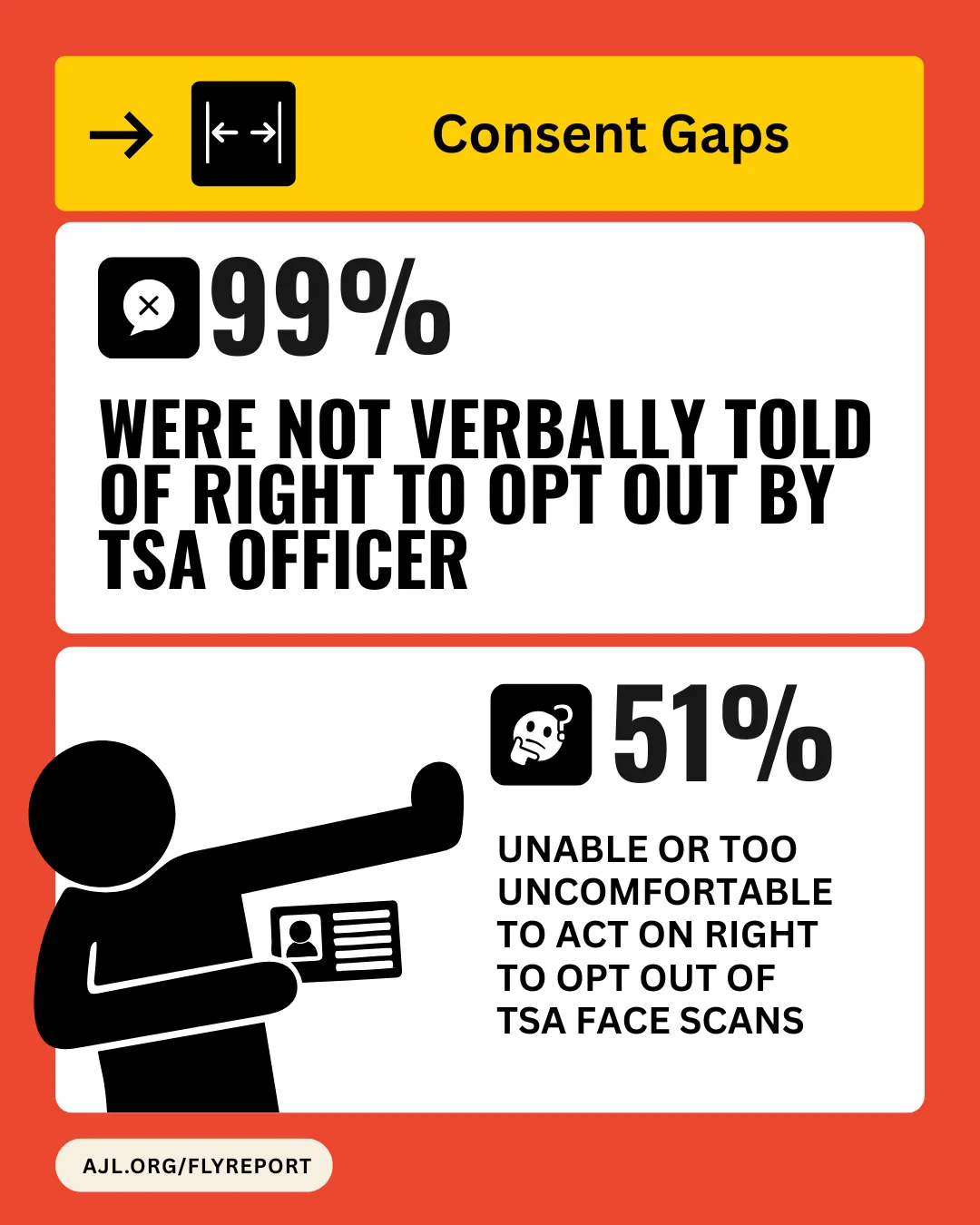
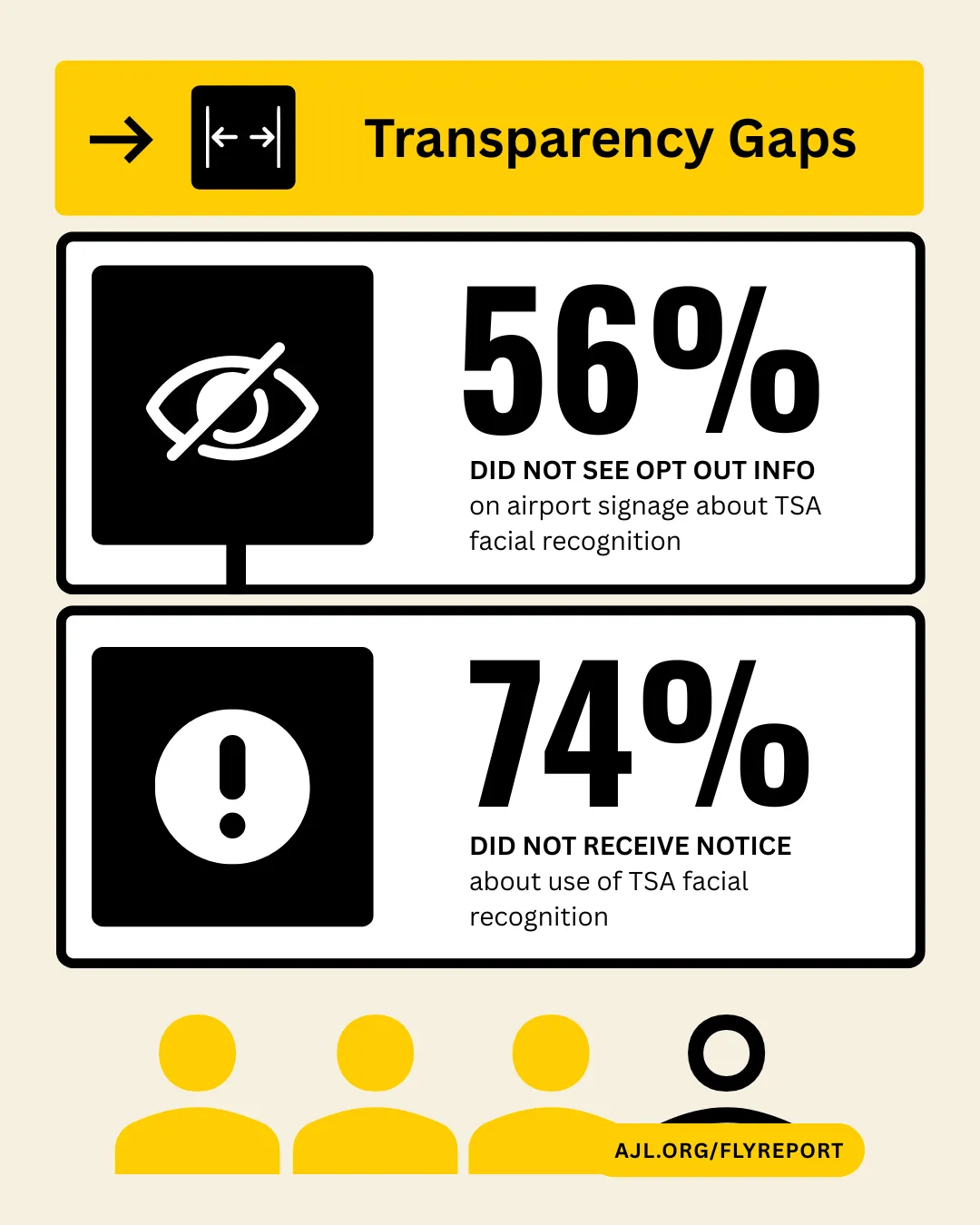
Informed Consent is not consistently achieved by the TSA Facial Recognition Program. Many travelers are not informed about the opt out implementation of the program and/or given the opportunity to opt out.

#3 Poor Treatment

Some travelers face verbal abuse, hostile body language, increased scrutiny and other injuries to dignity and respect when attempting to opt out.

recommendations

social media toolkit

halt facial recognition experiment

The Algorithmic Justice League recommends a halt of the TSA’s use of facial recognition to allow for public deliberation and to address the concerns raised by the traveling public, civil society organizations, bipartisan elected officials, and even the U.S. government’s own Privacy and Civil Liberties Oversight Board (PCLOB).

#1 Preserve Freedom and privacy

High risk technologies with the potential for mass biometric surveillance should never be mandatory, and the evidence of benefits should outweigh documented harm and credible risks.

#2 PROMOTE INFORMED PUBLIC DECISION MAKING

Any experimental biometrics program, if congressionally approved, must be set up as opt-in. Opt-out does not work, given the perception among travelers that the program is mandatory and given the power imbalances between the traveler and the TSA officer. In order to be perceived as trustworthy, any program must be developed with full public knowledge and informed decision making, and without perceived coercion.

#3 PREVENT & REDRESS DISRESPECTFUL TREATMENT

Given the feedback received from hundreds of travelers across 91 airports in the U.S., AJL calls for immediate and actionable steps to be undertaken by TSA to ensure respect and dignity for all travelers. Millions of people across the U.S. travel daily for professional and personal purposes, with little understanding of how the FRT program operates and little recourse when experiencing disrespectful treatment at the hands of TSA officers if they wish to exercise their right to opt out.

Join the Algorithmic Justice League Newsletter.

Stay up to date with the movement towards equitable and accountable AI.